
Knowing Your Customer

Updated: Feb 16
Week Two: Knowing Your Customer (Before You Spend a Dollar on Marketing)
Most Marketing Fails Because It Talks to the Wrong Person
When marketing doesn’t work, most business owners assume:
The ad was bad
The platform was wrong
The timing was off
More often, the problem is simpler:
The message wasn’t meant for the person who saw it.
You can have a great product, fair pricing, and good intentions — and still struggle — if you don’t clearly understand who your customer is.
Marketing doesn’t start with ads. It starts with empathy.
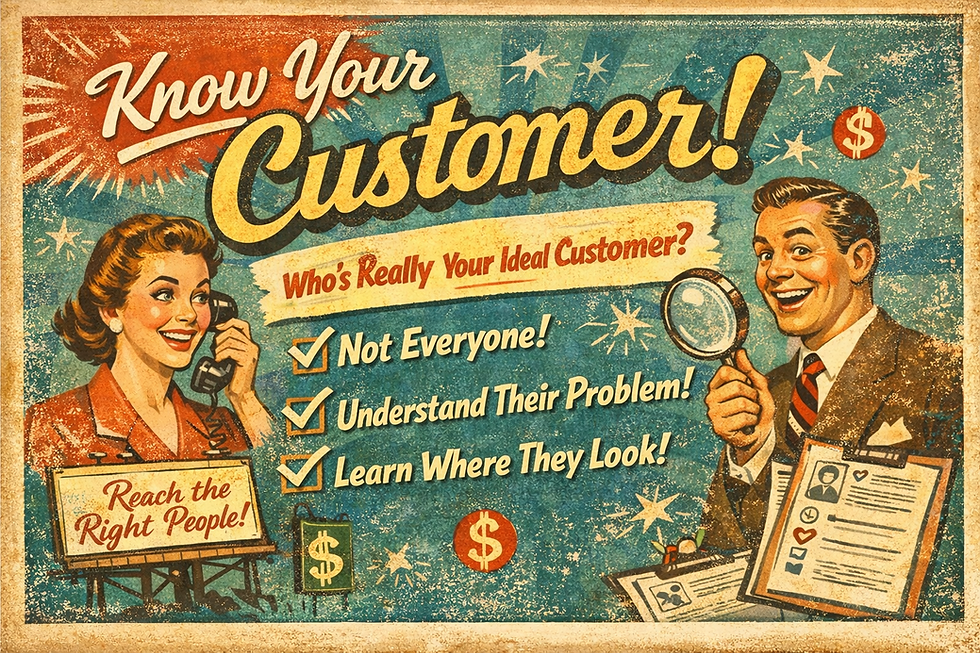
Step One: Your Customer Is a Person, Not “Everyone”
One of the most common beginner mistakes is saying:
“Our customer is everyone.”
That sounds safe, but it makes your message invisible.
Instead of “everyone,” ask:
Who needs this the most?
Who says yes the fastest?
Who benefits the most from what we do?
You’re not excluding anyone. You’re choosing who you’re speaking to.
Step Two: Identify Their Real Problem
Customers rarely buy what they say they’re buying.
They say:
“I need a sign.”
“I need advertising.”
“I need a website.”
“I need a new supplier.”
What they usually mean:
“I’m confused.”
“I’m frustrated.”
“I’m losing time or money.”
“I don’t trust the options.”
Good marketing speaks to the real pain, not just the product.
Ask:
What problem pushed them to start looking?
Step Three: Understand How They Make Decisions
Different customers decide differently.
Some:
Research for weeks
Read reviews
Compare options
Others:
Ask a friend
Call the first business they trust
Choose familiarity over price
Ask yourself:
Do my customers research or rely on referrals?
Do they value speed, trust, price, or simplicity?
Are they emotional buyers or logical buyers?
This determines where and how you market.
Step Four: Listen Before You Speak
Your best marketing data is already around you.
Listen to:
Phone calls
Emails
In-person questions
Objections before a sale
Pay attention to:
Repeated phrases
Common hesitations
What people ask first
Great marketing uses your customer’s words — not marketing language.
Step Five: Write Your Customer Snapshot
You don’t need a complicated persona.
Answer these honestly:
My best customer is: ____________________
They struggle most with: ____________________
They want relief because: ____________________
They usually find us by: ____________________
This becomes your marketing filter.
If something doesn’t speak to this person, it doesn’t go out.
One Action for Week Two
This week:
Ask three customers how they found you
Ask one customer what almost stopped them from buying
Write down the exact words they use
Those words are future marketing gold.
Final Thought for Week Two
Marketing works best when customers feel:
“They get me.”
When people feel understood, trust forms fast. When trust forms, tools start working.



Comments