
The Work Behind the Growth: A Different Kind of Sales Role in Indiana

In towns and cities across Indiana, growth rarely happens by accident. It’s built—conversation by conversation, decision by decision, often by people willing to take a chance on something new. Behind many of those moments is a role that doesn’t always get recognized for what it really is: the work of helping a business move forward.
At Apparel & Graphics, sales exist in that space.
It doesn’t begin with a script or a pitch deck. More often, it starts with a question. A business owner trying to get noticed. A company looking to expand into a new market. A team trying to stay relevant in a world where attention is increasingly difficult to capture. What follows is less about selling a single service and more about understanding where that business is—and where it could go.
The work itself is broad by design. A conversation might lead to a vehicle wrap that turns a daily route into a moving advertisement, or a radio campaign that reaches into homes, job sites, and work trucks across the region. It could become a television commercial, a digital ad strategy, or a presence in print through magazines, business cards, and promotional materials. There are embroidery programs, branded apparel, and physical signage that make a company visible in the real world. There are search strategies through SEO that help customers find a business when they need it most, and direct mail campaigns that reach entire communities through the USPS.
Individually, each of these is a product. Together, they form a system.
For the person in a sales role, that system changes the nature of the job. There is no single lane to stay in, no single answer that fits every situation. Instead, the work becomes a process of listening closely, understanding context, and aligning the right mix of tools to help a business grow. Some clients are just getting started, built around a single person and an idea. Others are established operations with teams and infrastructure already in place. The approach doesn’t depend on size. It depends on need.
What makes the role distinct is what happens when conditions change.
Markets shift. Costs rise. Customers behave differently. For many businesses, those moments create pressure—sometimes enough to slow progress or threaten stability. At Apparel & Graphics, the response is not to step back, but to lean in. Strategies adjust. Plans evolve. The goal becomes not just growth, but resilience—helping clients navigate through uncertainty and come out stronger on the other side.
That perspective is not theoretical. It is shaped by leadership that has built and operated multiple companies across different industries for more than two decades. There is an understanding, earned through experience, of what it actually takes to run a business—not just when things are working, but when they are not. That experience carries into the conversations sales professionals have every day.
It also creates a different kind of confidence.
You are not representing a single product or a narrow offering. You are working with a full range of marketing and branding capabilities designed to support real business outcomes. That breadth allows for more meaningful conversations and more effective solutions, but it also requires a higher level of ownership. There is an expectation that you will think beyond transactions, build relationships, and stay engaged over time.
The role asks for initiative. It asks for consistency. It asks for the willingness to build something rather than inherit it.
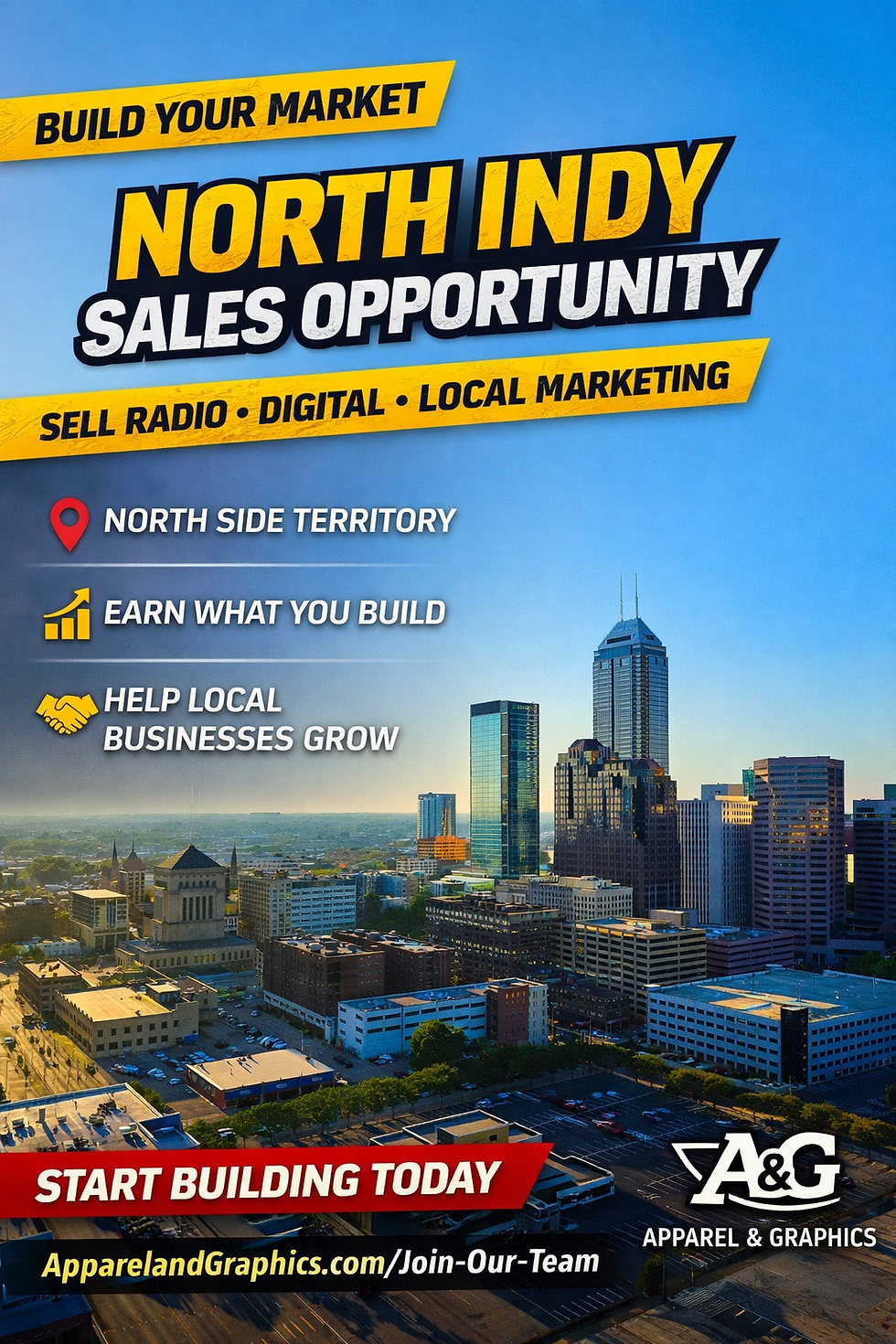
In return, it offers something that is increasingly rare. The ability to develop your own territory. To create a book of business that reflects your effort. To earn based on what you produce, not what is assigned. And to see, in a tangible way, the results of your work—in the businesses that grow, the brands that become visible, and the communities that benefit from that growth.
Apparel & Graphics does not position itself as the only company doing this work. It recognizes that there are others in the market. What it focuses on instead is how the work is done—consistently, deliberately, and with an understanding of what is at stake for the businesses it serves.
Because when a business grows, it does more than increase revenue. It creates jobs. It supports families. It strengthens the local economy. And in many cases, it gives someone the opportunity to keep going when the alternative might have been closing the doors.
For the people in sales, that is the part that stays with you.
It’s not just about what you sell. It’s about what you help build.


Comments